Intra-Articular Hip Injection: Treatment, Diagnosis, and What to Expect
Intra-articular hip injection is a procedure in which medication is delivered directly into the hip joint. Because the hip is a deep joint surrounded by important nerves and blood vessels, injections are commonly performed under ultrasound or fluoroscopic guidance to improve accuracy and safety.
Hip injections may serve two main purposes: therapeutic and diagnostic.
Therapeutic Hip Injections
Therapeutic injections are used primarily to reduce pain and inflammation.
The most commonly used medications are:
- Local anesthetic
- Corticosteroid
- In selected circumstances, hyaluronic acid
A local anesthetic may be combined with corticosteroid to provide immediate temporary pain relief while the anti-inflammatory effect of the corticosteroid develops.
For patients with symptomatic hip osteoarthritis, intra-articular corticosteroid injection can provide short-term improvement in pain and function. The duration of benefit varies considerably between patients, but current evidence supports benefit primarily over the first several weeks and, in some studies, up to approximately 8–12 weeks. Longer-lasting relief may occur in individual patients, but it should not be expected or guaranteed. American Academy of Orthopaedic Surgeons
Corticosteroid injection does not reverse cartilage loss or cure osteoarthritis. It should therefore be considered a temporary symptom-management option rather than a disease-modifying treatment.
Diagnostic Hip Injection
Hip pain can sometimes be difficult to localize.
Pain originating from the hip joint may overlap with symptoms caused by the lumbar spine, sacroiliac region, muscles, tendons, or other structures around the hip.
This is particularly relevant in patients with hip-spine syndrome, where both hip and lumbar pathology may be present.
For diagnostic purposes, a local anesthetic is injected into the hip joint. The patient is then reassessed to determine whether the pain has substantially improved.
A marked reduction in pain following an accurately placed intra-articular anesthetic injection supports the hip joint as an important source of the patient’s symptoms.
However, the test should not be interpreted as an absolute confirmation or exclusion of hip pathology. Clinical examination, imaging, and the overall pattern of symptoms remain important.
Guided intra-articular hip injections have shown useful diagnostic performance in patients with overlapping hip and lumbar symptoms and can be particularly valuable when the source of pain is uncertain. PubMed
What Is the Role of Hyaluronic Acid?
Hyaluronic acid, or HA, is commonly used for osteoarthritis in some joints, particularly the knee.
The situation is different in the hip.
For symptomatic hip osteoarthritis, current high-quality evidence does not demonstrate clinically meaningful improvement in pain or function compared with placebo.
The American Academy of Orthopaedic Surgeons therefore gives a strong recommendation that intra-articular hyaluronic acid should not be used routinely for symptomatic hip osteoarthritis. American Academy of Orthopaedic Surgeons
In the United States, HA products are also not FDA-approved specifically for intra-articular treatment of the hip. OrthoInfo
Does This Mean HA Has No Role in the Hip at All?
Not necessarily.
Most major clinical guidelines addressing HA focus specifically on hip osteoarthritis.
They do not establish recommendations for every non-arthritic hip disorder, such as:
- Femoroacetabular impingement (FAI)
- Hip dysplasia
- Labral pathology
- Selected chondral lesions
- Persistent intra-articular symptoms after hip arthroscopy
Evidence for HA in these situations remains limited.
Therefore, HA injection may occasionally be considered on an individualized, off-label basis in selected patients when other treatment options have been exhausted and when the patient understands that supporting evidence is weak and benefit is uncertain.
Importantly, HA should not be presented as a proven treatment for these conditions.
What About HA After Hip Arthroscopy for FAI?
Routine HA injection after arthroscopic treatment of femoroacetabular impingement is not currently supported by strong evidence.
Most postoperative management after hip arthroscopy focuses on:
- Rehabilitation
- Restoration of range of motion
- Progressive strengthening
- Management of inflammation
- Correction of movement patterns
- Gradual return to activity
If persistent pain occurs after surgery, the priority should usually be to identify the cause rather than automatically proceeding to HA injection.
Possible causes include:
- Residual or recurrent impingement
- Persistent synovitis
- Labral or chondral pathology
- Iliopsoas irritation
- Capsular problems
- Adhesions
- Muscle weakness
- Heterotopic ossification
- Progressive osteoarthritis
In selected patients with persistent intra-articular symptoms and associated cartilage damage, HA may sometimes be considered as an individualized salvage option. However, patients should understand that this is not an established standard treatment.
Why Is Image Guidance Important?
The hip joint lies relatively deep beneath the skin and is surrounded by major neurovascular structures.
For this reason, accurately placing a needle inside the joint using surface landmarks alone can be difficult.
Image guidance substantially improves accuracy, particularly in deep joints such as the hip. PubMed
The two most commonly used methods are:
Ultrasound Guidance
Ultrasound allows the physician to visualize:
- The femoral head and neck
- Joint capsule
- Needle trajectory
- Nearby blood vessels
Advantages include:
- No ionizing radiation
- Real-time visualization
- Ability to assess adjacent soft tissues
Fluoroscopic Guidance
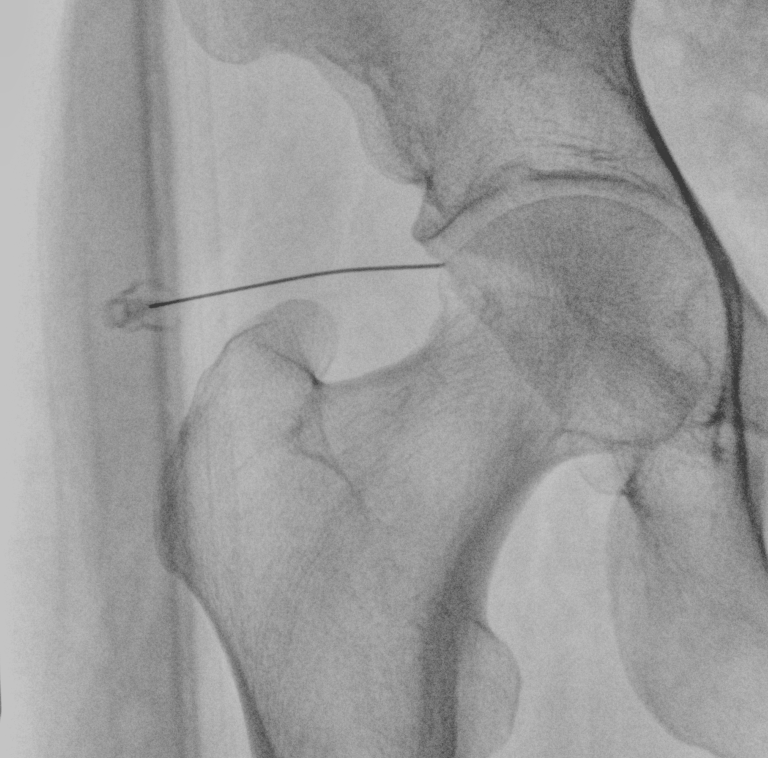
Fluoroscopy uses X-ray imaging, often combined with a small amount of contrast material, to confirm that the needle is inside the joint.
Both ultrasound and fluoroscopy are established techniques. Current evidence does not conclusively show that one method is universally superior to the other in clinical outcomes. PubMed
What About Landmark-Guided Injection?
Landmark-guided hip injection is considerably less reliable than image-guided injection.
In a classic cadaveric study, an anterior landmark-based approach entered the joint successfully in only 60% of attempts, while a lateral approach achieved approximately 80% accuracy. The anterior technique also placed the needle relatively close to important neurovascular structures. PubMed
More recent clinical research similarly demonstrates substantially higher accuracy with ultrasound guidance than with blind landmark-based injection. PubMed
For this reason, image guidance is generally preferred whenever available.
This becomes particularly important when the injection is being used diagnostically: if the medication is unintentionally deposited outside the joint, the response may be misleading and potentially lead to an incorrect conclusion regarding the source of pain.
What to Expect During the Procedure
Most hip injections are performed as an outpatient procedure.
The patient is typically positioned lying down.
The skin is cleaned using sterile technique, and ultrasound or fluoroscopy is used to identify the joint.
A needle is then advanced into the joint and the selected medication is injected.
The procedure itself usually takes only a few minutes.
Patients undergoing diagnostic injection may be asked to perform movements or activities that normally provoke their symptoms before and after the injection so that the response can be assessed.
Are There Risks?
Hip injections are generally well tolerated, but potential complications include:
- Temporary increase in pain
- Bleeding or bruising
- Infection
- Allergic reaction
- Transient numbness or weakness from local anesthetic
- Steroid-related temporary elevation in blood glucose
- Very rarely, injury to nearby nerves or blood vessels
Repeated corticosteroid injections should be considered carefully, particularly in patients with progressive osteoarthritis.
The Bottom Line
Intra-articular hip injection can be useful for both short-term symptom management and diagnostic clarification.
Corticosteroid injections may provide temporary relief in symptomatic hip osteoarthritis, whereas diagnostic anesthetic injections can help determine whether pain is arising from within the hip joint.
Hyaluronic acid is not recommended as a routine treatment for hip osteoarthritis, because high-quality evidence has not shown meaningful benefit over placebo.
Its role in non-arthritic hip conditions—including FAI, hip dysplasia, and persistent symptoms after hip arthroscopy—remains uncertain and should be considered experimental or individualized rather than standard treatment.
Because the hip is a deep joint, ultrasound- or fluoroscopic-guided injection is preferred to improve accuracy and reduce the possibility of extra-articular injection.