Exercises Before Hip Replacement: How to Prepare Your Body for Surgery
A Practical Guide to Prehabilitation Before Total Hip Replacement
Preparing for hip replacement surgery involves more than simply scheduling the operation. One of the most important things you can do before surgery is prepare your body for the recovery process.
Patients with advanced hip osteoarthritis often experience pain, stiffness, muscle weakness, and difficulty performing everyday activities. As hip symptoms become more severe, patients naturally tend to move less. Unfortunately, reduced activity can gradually lead to muscle weakness, poor balance, and declining physical endurance.
Although hip replacement surgery can relieve joint pain and improve mobility, replacing the damaged joint does not immediately restore the strength and physical conditioning lost before surgery.
This is where prehabilitation, or preoperative exercise, becomes valuable.
The goal of preoperative exercise is not to “train through” a damaged hip. It is to maintain strength, mobility, cardiovascular fitness, and confidence so that the body is better prepared for recovery after surgery.
What Is Prehabilitation Before Hip Replacement?
Prehabilitation is a structured program of exercise, physical conditioning, and patient education performed before surgery.
Unlike traditional rehabilitation, which focuses on recovering function after surgery, prehabilitation aims to improve or maintain physical readiness before the operation.
A well-designed prehabilitation program may help patients maintain functional performance, mobility, and confidence, while making early postoperative exercises and everyday activities easier to manage.
Some studies also suggest benefits for preoperative pain and physical function. However, research findings are mixed, and improvements in postoperative recovery are not consistently demonstrated across all patients.
The purpose is not necessarily to make patients dramatically stronger before surgery, but to help them enter surgery in the best physical condition their hip disease safely allows.
Importantly, exercises should not aggravate the painful hip or cause prolonged symptom flare-ups.
The Five Pillars of Prehabilitation
An effective exercise program before hip replacement can be organized into five essential components:
Strength → Mobility → Aerobic Fitness → Functional Training → Education
Each component prepares the body for a different aspect of postoperative recovery.
1. Strength: Maintain the Muscles You Will Need After Surgery
Muscle strength is one of the foundations of functional recovery following hip replacement.
Patients with chronic hip pain commonly develop weakness in several muscle groups because of pain-related inactivity and changes in their walking patterns.
The most important muscles to maintain include:
- Hip abductors (gluteus medius and minimus): Help stabilize the pelvis during walking and single-leg support.
- Hip extensors (particularly gluteus maximus): Help with standing, walking, and climbing stairs.
- Quadriceps: Important for rising from a chair, walking, and controlling the knee.
- Hamstrings: Assist with hip and knee movements.
- Core and trunk stabilizers: Support posture, balance, and coordinated movement.
- Upper-extremity muscles: Particularly important for patients who will use a walker or crutches after surgery.
Maintaining the strength of these muscles can make everyday movements and early rehabilitation more manageable.
Recommended strengthening exercises
Depending on individual ability, useful exercises may include:
- Sit-to-stand exercises
- Mini squats
- Gluteal squeezes
- Bridging, if comfortable
- Standing hip abduction
- Standing hip extension
- Seated knee extension, with or without light resistance
- Calf raises
Not every patient needs to perform all these exercises.
For example, someone with severe hip arthritis may find mini squats or bridging uncomfortable but may perform seated knee extensions and gluteal squeezes without difficulty.
The exercise program should be simple, practical, and easy enough to perform consistently.
The best exercise is not necessarily the most challenging one. It is the exercise the patient can perform safely, comfortably, and regularly.
2. Mobility: Preserve Movement Without Forcing a Painful Hip
Hip osteoarthritis often causes progressive loss of joint mobility, particularly hip rotation, extension, and flexion.
Maintaining available joint movement is important for activities such as walking, dressing, sitting, and getting in and out of bed.
However, patients should understand that hip stiffness can result from structural changes within the joint, including cartilage loss, osteophytes, and joint deformity.
These structural limitations cannot always be corrected through stretching.
Attempting to force a severely arthritic hip into a normal range of motion may aggravate joint irritation and increase pain.
The goal should therefore be to preserve comfortable movement rather than aggressively restore normal motion.
Gentle mobility exercises may include:
- Comfortable hip flexion and extension
- Gentle hip abduction
- Hip rotation within a pain-free or tolerable range
- Heel slides
- Gentle lower-limb movements in lying or sitting positions
Movements should be slow and controlled, without bouncing or forcing the joint.
In patients with severe arthritis or fixed deformity, the orthopedic surgeon or physical therapist may recommend avoiding certain stretching exercises altogether.
Remember: Maintain the movement you have. Do not force a damaged hip into painful positions.
3. Aerobic Fitness: Prepare Your Heart and Lungs for Recovery
Muscle strength alone is not enough for successful postoperative recovery.
Consider a patient who has enough muscle strength to stand and walk but becomes exhausted after only a short distance.
Even if the new hip functions well, poor endurance may limit the patient’s ability to participate in rehabilitation and perform everyday activities.
Aerobic conditioning helps maintain cardiovascular fitness and physical endurance.
The challenge is that many patients awaiting hip replacement cannot comfortably perform conventional exercises such as prolonged walking.
For this reason, low-impact aerobic activities are generally preferred.
Suitable options may include:
- Walking on level ground
- Stationary cycling
- Swimming or aquatic exercise
- Water walking
- Elliptical training, if tolerated
- Arm ergometer exercise for patients with severe walking limitations
The most appropriate activity depends on which movements provoke hip symptoms.
For example, a patient who develops significant groin pain after walking may tolerate stationary cycling better than walking several kilometers each day.
Similarly, aquatic exercise may be useful for patients who struggle with weight-bearing activities because of severe arthritis or obesity.
The goal is to improve or maintain cardiovascular endurance without unnecessarily increasing stress on the painful hip.
Start with a manageable duration, even 5–10 minutes if necessary, and gradually increase according to tolerance.
4. Functional Training: Practice the Movements You Will Need After Surgery
Strengthening individual muscles is useful, but the ultimate goal is to make those muscles work together during everyday activities.
This is known as functional training.
After hip replacement, patients need to perform several essential movements safely, often beginning on the day of surgery or the following day.
Practicing these activities before surgery helps patients become familiar with the movements and may improve their confidence during early recovery.
Important functional exercises include:
Sit-to-stand training
Practice rising from a stable chair and sitting down in a controlled manner. Use the armrests when necessary.
This movement requires coordinated activity from the hip extensors, quadriceps, trunk muscles, and upper extremities.
Getting in and out of bed
Learn how to move the legs, turn the body, and transfer safely between lying and sitting positions.
Walking practice
Maintain a comfortable, safe walking pattern. Patients who limp significantly may benefit from an appropriate walking aid even before surgery.
Stair climbing
Practice safe stair negotiation when appropriate, particularly if stairs are unavoidable at home.
Walker or crutch training
Patients expected to use walking aids after surgery can learn correct positioning, hand placement, turning, and walking techniques in advance.
Balance training
Simple supported exercises, including weight shifting and standing balance, may help maintain stability and reduce the risk of falling.
Not every patient needs an intensive functional training program. The exercises should reflect the patient’s current condition and the activities they will need during recovery.
The purpose of functional training is not simply to exercise more, but to practice moving better.
5. Education: Learn How to Recover Before Surgery Happens
Prehabilitation is not only about muscle conditioning and fitness.
One of its most valuable components is preparing patients to understand what will happen after surgery and what they will be expected to do.
Immediately after hip replacement, patients may experience surgical discomfort, fatigue, anxiety, and the effects of anesthesia or medications.
Learning unfamiliar exercises and movement techniques for the first time during this period can be challenging.
For this reason, postoperative exercises and mobility techniques should ideally be introduced before surgery.
Important exercises and skills to learn include:
- Ankle pumps
- Quadriceps sets
- Gluteal sets
- Heel slides, according to the postoperative protocol
- Bed mobility
- Sit-to-stand techniques
- Safe walking with a walker or crutches
- Getting in and out of a chair
- Stair negotiation when needed
Patients should also understand their surgeon’s postoperative instructions, including weight-bearing status, wound care, and any specific movement restrictions.
Practicing these activities in advance may reduce uncertainty and help patients participate more confidently in early rehabilitation.
Prehabilitation is not just exercise conditioning. It is a rehearsal for recovery.
The Most Important Rule: Stay Active Without Aggravating Your Hip
One of the most common questions patients ask is:
“Should I continue exercising even if my hip hurts?”
In most cases, the answer is yes, but with important limitations.
Patients should not stop all physical activity simply because they have hip pain.
Complete inactivity can contribute to further muscle weakness, joint stiffness, reduced endurance, and declining functional ability.
However, exercising aggressively through significant pain can also be counterproductive.
The key principle is:
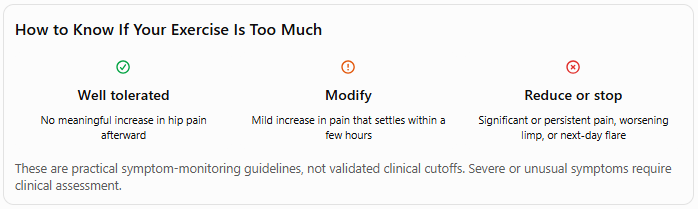
Exercise should challenge the patient, but should not significantly worsen hip pain afterward.
A small, temporary increase in discomfort during exercise may be acceptable if it settles back to the usual baseline within a few hours.
However, if exercise causes a substantial increase in groin pain, worsened limping, or symptoms that persist into the following day, the program may be too demanding.
In this situation, consider:
- Reducing exercise intensity
- Lowering resistance
- Performing fewer repetitions
- Reducing the range of motion
- Switching to a lower-impact activity
- Allowing additional recovery time
These are practical guidelines rather than rigid pain thresholds. Patients should follow individualized advice, especially when their underlying diagnosis requires activity or weight-bearing restrictions.
The aim is to remain as active as possible without provoking a prolonged pain flare-up.
Prehabilitation Should Be Individualized
There is no single exercise program suitable for everyone undergoing hip replacement.
Patients differ in age, disease severity, muscle strength, functional limitations, general health, and tolerance for physical activity.
A successful prehabilitation program should reflect these differences.
Patients With Mild to Moderate Functional Limitations
Patients who can still walk relatively comfortably may participate in a more comprehensive program combining strengthening, aerobic conditioning, mobility, and functional exercises.
Patients With Severe Hip Osteoarthritis
When walking and weight-bearing exercises cause substantial pain, the program may need to emphasize seated exercises, gentle strengthening, stationary cycling, or aquatic exercise.
Forcing patients to walk long distances despite significant hip pain is usually unnecessary.
Patients With Significant Hip Abductor Weakness
Exercises may place greater emphasis on hip abductor strengthening, pelvic stability, gait training, and balance.
Older or Frail Patients
For older adults with reduced strength, poor balance, or a higher risk of falling, simple functional exercises may be more valuable than heavy resistance training.
Sit-to-stand practice, safe walking, balance training, and fall prevention should be prioritized.
Patients With Obesity
The focus should include cardiovascular conditioning, muscle strength, and practical functional capacity while minimizing excessive loading of the painful hip.
Low-impact exercises may be especially helpful.
Patients With Other Medical Conditions
Patients with significant cardiovascular or respiratory disease, neurological problems, severe osteoporosis, or other complex conditions may require medical assessment and a supervised program.
The goal is not to make every patient perform the same exercises, but to help each patient achieve the best possible physical condition before surgery.
How Often Should You Exercise Before Hip Replacement?
The ideal frequency depends on the patient’s condition, exercise tolerance, and the time available before surgery.
The following schedule provides a general starting framework:
| Type of exercise | Suggested frequency |
|---|---|
| Muscle strengthening | 2–3 days per week |
| Aerobic conditioning | 3–5 days per week |
| Gentle mobility exercises | Daily, as tolerated |
| Functional movement practice | Several times per week |
| Recovery education | Before surgery, with reinforcement as needed |
Many patients can work toward approximately 20–40 minutes per session, although shorter sessions may be more appropriate for those with severe symptoms or limited endurance.
Patients do not need to complete every exercise in a single session.
For example, strengthening exercises can be performed in the morning, while short aerobic or mobility sessions can be completed later in the day.
The priority is consistency, not maximum exercise intensity.
When Should You Start Prehabilitation?
Ideally, prehabilitation should begin several weeks before a planned hip replacement.
A period of approximately 4–8 weeks provides a reasonable opportunity to develop an exercise routine, maintain or improve strength, and practice functional activities.
However, this is a practical planning timeframe rather than a mandatory requirement.
Even when only 2–3 weeks are available, patients may still benefit from learning exercises, practicing walking aid techniques, and preparing for postoperative rehabilitation.
Importantly, surgery should not necessarily be delayed simply to complete a prehabilitation program.
For patients with severe symptoms, maintaining existing physical function and preventing further deconditioning may be a more realistic goal than achieving measurable strength gains.
Exercises and Activities to Avoid Before Hip Replacement
Patients with advanced hip arthritis should be cautious about exercises that place excessive stress on the painful joint or produce prolonged symptoms.
Activities that may need to be avoided or modified include:
- Heavy, deep squats
- High-impact running or jumping
- Aggressive stretching through painful hip movements
- Heavy resistance training beyond current capacity
- Exercises that consistently provoke significant groin pain
- Long-distance walking despite worsening pain or limping
- Sudden increases in training intensity immediately before surgery
These are not absolute restrictions for every patient. The decision depends on symptoms, physical capacity, and the underlying hip condition.
The final days before surgery are not the time to attempt major improvements in strength or fitness.
Instead, patients should maintain gentle activity, avoid unusually strenuous exercise, and allow adequate recovery.
Ideally, you should enter surgery without an exercise-related pain flare-up, significant muscle fatigue, or a new injury.
Does Prehabilitation Really Improve Recovery After Hip Replacement?
Prehabilitation is a reasonable and potentially beneficial part of preparing for total hip replacement.
Research suggests that structured preoperative exercise may improve certain aspects of physical function, mobility, and symptoms before surgery.
Some patients may also find it easier to participate in postoperative exercises because they are already familiar with the movements and have maintained their physical conditioning.
However, clinical studies have not consistently demonstrated substantial improvements in postoperative functional outcomes, hospital length of stay, or complication rates.
Results vary depending on the patient’s baseline condition, the exercise program, and how outcomes are measured.
Therefore, prehabilitation should not be presented as a guarantee of faster recovery.
Its practical value lies in helping patients preserve physical capacity, learn important skills, and enter surgery better prepared for rehabilitation.
Final Thoughts: Prepare Your Body, Not Just Your Hip
Total hip replacement is designed to address the damaged joint, relieve pain, and restore mobility.
However, successful recovery involves much more than the artificial hip itself.
Muscle strength, balance, endurance, movement confidence, and the ability to perform everyday activities all contribute to the rehabilitation process.
Prehabilitation helps patients prepare these physical abilities before surgery.
The five essential pillars are:
Strength → Mobility → Aerobic Fitness → Functional Training → Education
The most important principle is to remain physically active within the limits of the painful hip rather than forcing the joint through aggressive exercise.
The goal is not to enter surgery with the strongest muscles possible. It is to enter surgery with a body that is ready to recover.
A thoughtful, individualized prehabilitation program can help patients approach hip replacement with greater confidence and a clearer understanding of the recovery process.
Medical Disclaimer: This article provides general educational information and does not replace individualized medical advice. Patients should discuss their exercise plans with their orthopedic surgeon or physical therapist, especially if they have severe pain, substantial deformity, unstable gait, or a condition requiring restricted weight bearing.